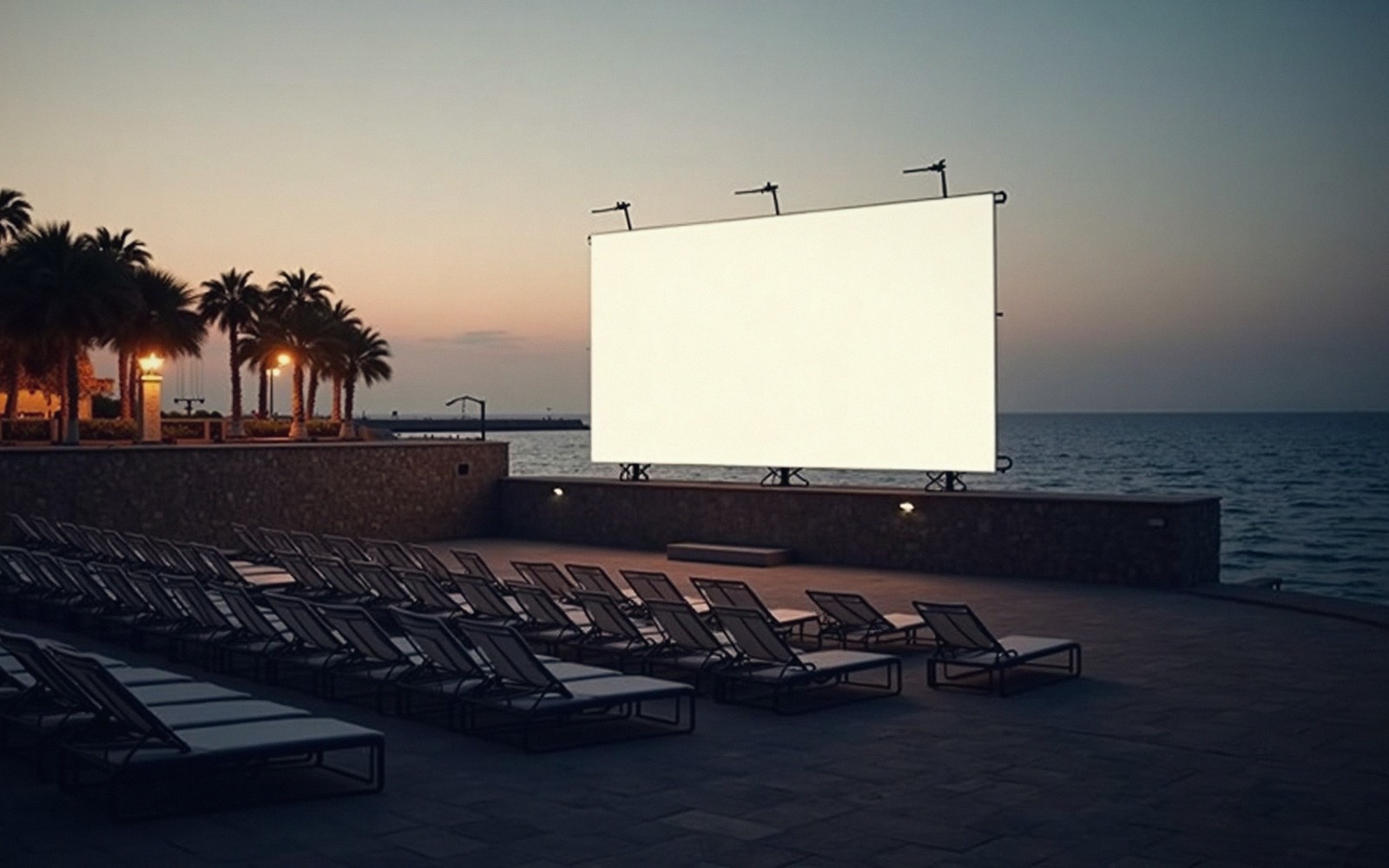
The Machine Arrives in the South
The Lumière brothers screened their first films in Paris in December 1895, in a basement salon on the Boulevard des Capucines. Within eighteen months, the machine had reached southern Italy. It came the way everything came to the Mezzogiorno: by sea, slowly, carried by travelling showmen who loaded projectors and reels onto carts alongside medicine, cloth and wonder. These early exhibitors set up wherever they found a crowd — market squares, church courtyards, the cleared floor of an osteria — and charged a few centesimi for the spectacle of images that moved.
The cinema hall, as a dedicated building, came later and unevenly to the south. In Naples, proper theatres arrived quickly. In smaller coastal towns and on the islands, they arrived barely at all, or arrived as converted spaces — a warehouse, a masseria's courtyard, a nobleman's stable — that were never quite enclosed. The climate made the argument for outdoors before anyone thought to articulate it: why pay to roof a building when the air is warm eight months of the year and the sky is wider than any ceiling you could raise?
By the 1930s, the arena estiva — the summer open-air cinema — had become a recognisable institution across the Italian south and its islands. These were not improvised screenings but proper seasonal venues: folding chairs or stone steps, a whitewashed wall or a stretched screen, a projection booth improvised from a shed, a handwritten placard listing the evening's programme. Towns that could not support a winter cinema hall could fill an open courtyard three nights a week from June to September. The screen went up when the fishing boats went out less, when the heat made indoor rooms unbearable, when the whole town already spent its evenings in the piazza doing nothing in particular.
The Golden Age of the Courtyard
The postwar decades were the high-water mark of the arena. Italy's cinema industry was at its most prolific and self-confident — the neorealists had just remade what film could be, Cinecittà was running at full capacity, and audiences were hungry in a way that is difficult to imagine now. Admission was cheap, often cheaper than a coffee in a bar, and the social contract was loose in the best sense: you could arrive late, leave early, buy something from a vendor who moved through the rows, argue with a neighbour about the plot without particularly disrupting anyone. Children fell asleep in their parents' arms and were carried home. Dogs wandered in from the street.
The physical arrangement was improvisational and proud of it. The ideal wall was whitewashed limestone, broad and flat, oriented to catch the projector's throw without too much scatter. Coastal towns discovered that harbour walls were excellent for this — wide, pale, facing the right direction if you were lucky — and that the audience, seated with their backs to the water, would sometimes turn around between reels to watch a fishing boat work its lamp across the dark. The competition was not unwelcome.
Sound presented the first real technical headache. Early outdoor systems were so loud in the open air that neighbours who had not paid heard the dialogue as clearly as those who had. This was considered mildly scandalous and then simply accepted, as most things in the south are eventually accepted. The sound drifted. The cats in the alley learned to sleep through gunshots.
What the arena offered that no indoor cinema could was the sensation of the film dissolving into its actual surroundings. A sea chase on screen, with the real sea thirty metres behind you. A western sky filling with stars as the titles played, the real sky above performing the same slow darkening. Directors who shot in Sicily — and many did, from the neorealists onward through Luchino Visconti and Francesco Rosi and later the Taviani brothers — found that their footage, played back in an outdoor piazza on the island where it was made, acquired a strange doubling, a resonance between image and place that no theatre wall could reproduce.
Decline, Survival and the Long Return
Television arrived in Italian homes through the 1950s and 1960s, and then multiplied through the 1970s and 1980s, and the arena estiva contracted. Many closed. The smallest islands lost their screens altogether; the reels came less frequently, then stopped. On Lampedusa, as on most of the Pelagie islands, the infrastructure of organised outdoor cinema largely disappeared in the later decades of the twentieth century. What remained was the instinct: the understanding, still alive in every town of any size on the Italian coast, that summer evenings and projected images belong together.
What kept the tradition from dying entirely was a combination of stubborn municipalism and genuine nostalgia. Italian regional and municipal governments have historically subsidised summer cinema programmes in a way that would surprise countries more rigidly attached to the market. The arena was considered — and in many places still is — a form of civic provision, like a public fountain or a decent piazza: something a town owes its inhabitants as evidence that civilised life continues through the heat. Film clubs, cultural associations, parish organisations and, later, arts festivals took up the programming where municipal budgets thinned. The form persisted because it was too useful and too loved to disappear entirely.
The revival that has gathered pace since the early 2000s is partly that nostalgia made conscious, partly the discovery by a new generation of what their grandparents took for granted. In Rome, the Estate Romana programme has run riverside and rooftop screenings for decades. In Palermo, summer cinema animates courtyards that have been showing films for sixty years and look it — the plaster is worn, the chairs are plastic and mismatched, and the sight lines are good. On the smaller islands, the revival is quieter but perceptible: a projector borrowed from a cultural association, a bedsheet stretched between two fig trees, a harbour wall pressed into service for one August weekend. These screenings are often informal to the point of invisibility — no poster, no advance booking, a WhatsApp message from someone who knows someone — and all the better for it.
- December 1895Lumière brothers' first public screening, Paris
- By 1896–97travelling showmen bring cinema to southern Italy
- 1930sarena estiva established as a seasonal institution
- 1950s–60stelevision begins to draw audiences away from outdoor screens
- 1970s–80sfurther contraction; smallest islands lose organised outdoor cinema
- Early 2000s onwardsustained revival of outdoor cinema culture across Italy
For two hours the sky above you and the sky in the film are the same sky, lit by the same indifferent stars.
What the South Understood First
The specific genius of the Mediterranean open-air cinema, the thing that distinguishes it from the rooftop screenings and pop-up outdoor events of northern cities, is that it was never conceived as a novelty or an event. It was conceived as the only sensible way to watch a film in summer. You do not make a fuss about it. You bring a jacket for later, because even July nights turn cool an hour after midnight. You buy something cold from whoever is selling. You find a seat, or half a wall, or a section of stone steps that your back will regret in the morning. The film starts late — half past nine at the earliest, often ten, because it must be properly dark and the sky takes its time.
What the screen shows matters, though perhaps less than you might think. The experience is cumulative: the film, the air, the particular quality of Mediterranean darkness which is never fully black but a deep blue-grey lit from below by the water, the sounds that come in from outside the screen — a scooter, a cat, the creak of a fishing boat — and the way an audience that knows each other sits differently from one assembled from strangers. The film is the occasion. The occasion is everything else.
There is a reason that films which take place outdoors, or near water, or in the Italian south, seem to improve when watched this way. The frame relaxes. The distance between the world on screen and the world around you compresses until it almost disappears, and for two hours the sky above you and the sky in the film are the same sky, lit by the same indifferent stars. This is what the south understood before anyone else: that cinema was always, at its core, an outdoor medium, fighting a losing battle with four walls and a roof, waiting for summer to set it free.